
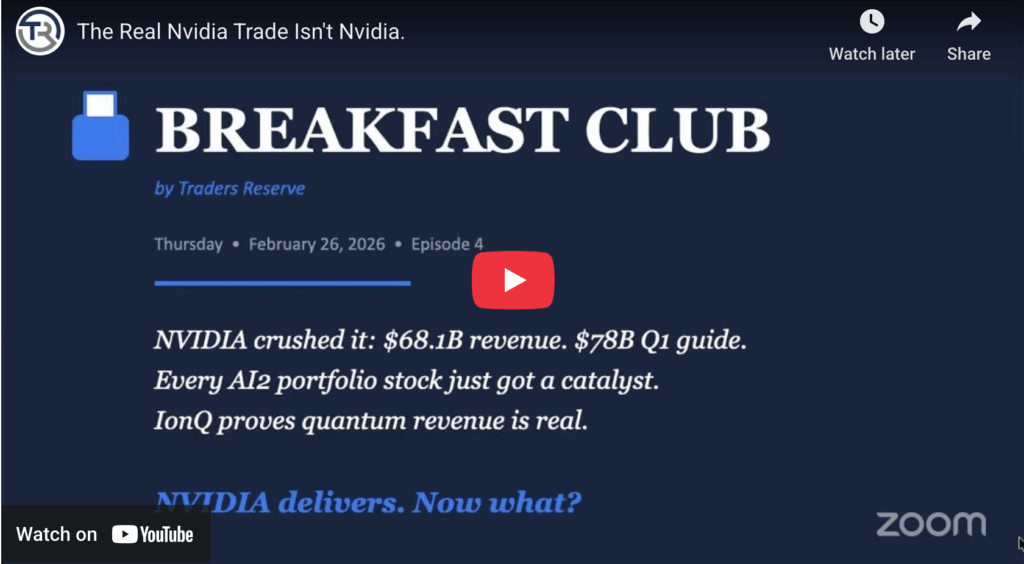
They hit the holy trinity. Wall Street yawned. But something bigger is happening underneath.
Welcome to the Breakfast Club, your weekly dose of market insights and trading strategies! Join us live every week at 9 AM ET on Traders Reserve Live, where John Hutchinson breaks down the latest market movements, shares actionable trade ideas, and answers your most pressing questions.
Nvidia reported earnings last night. Let me give you the headline: they beat. On everything.
Revenue — beat. Earnings — beat. Forward guidance — raised by 15% for the upcoming quarter. That’s not a small bump. That’s a company telling you that demand is not slowing down, that their pipeline is full, and that they see the road ahead getting bigger, not smaller.
In this business, we call that the holy trinity: beat EPS, beat revenue, raise guidance. It’s the trifecta that’s supposed to send a stock screaming higher.
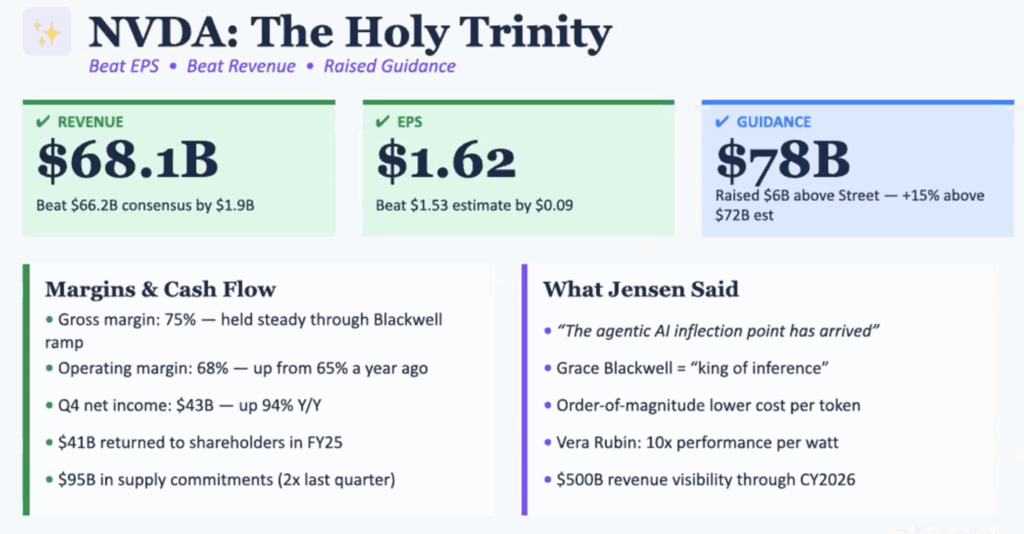
Nvidia’s stock this morning? Up less than 1%.
Why the Market Yawned
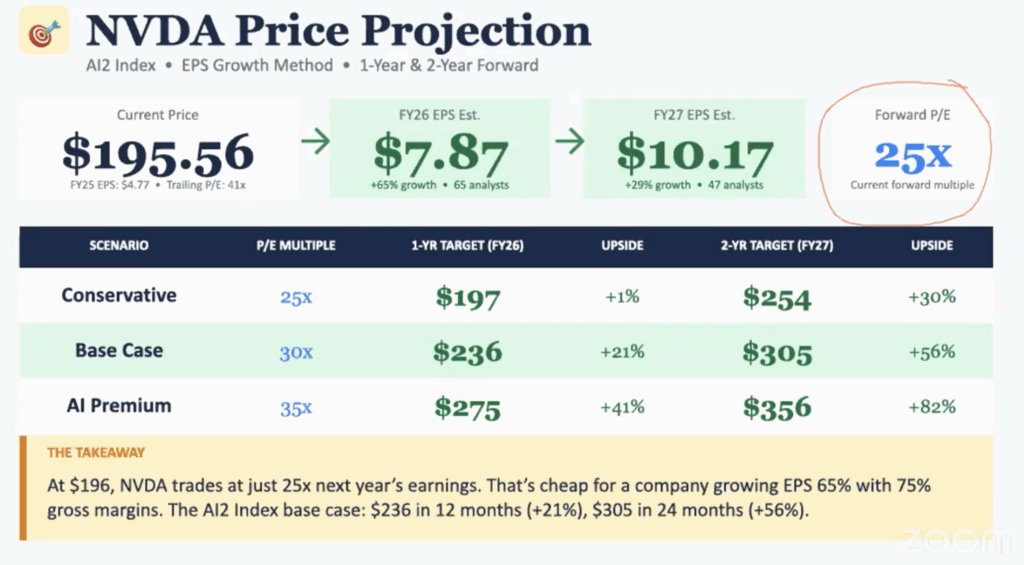
This shouldn’t surprise you if you’ve been following along. I told you yesterday — Nvidia doesn’t move like it used to on earnings day. Two years ago, an Nvidia beat would lift the entire market 1 to 2%. Not anymore. The stock has been range-bound between $175 and $200 since August. It’s too widely held, too heavily traded, too picked over by every algorithm on Wall Street for a single earnings report to break the range.
But here’s the thing most people are missing: Nvidia’s earnings day reaction doesn’t tell you what happens next. It tells you what’s already priced in. The real impact plays out over the next 30 to 90 days — and it doesn’t play out in Nvidia’s stock. It plays out across the entire AI supply chain.
That’s where the opportunity is right now. And that’s what I want to talk about.
What Jensen’s Tone Told Me
Before I get to the ripple effect, I want to flag something from the earnings call that caught my attention.
Jensen Huang — Nvidia’s CEO — was defensive. Not panicked. Not worried. But defensive. He and his team spent a meaningful chunk of the call defending their inter-company deals, defending the growth trajectory of their chips, defending the sustainability of AI demand.
Now, why would the CEO of the most dominant chip company in artificial intelligence feel the need to defend himself after beating on every metric?
Because Wall Street still has doubts.
There’s a concern — and I think it’s worth understanding even if I don’t fully agree with it — that some of the demand Nvidia is reporting is circular. Nvidia invests in OpenAI. OpenAI buys Nvidia chips. Meta buys Manus. Meta expands its chip orders. These inter-company deals create what some analysts are calling “false demand” — deals that look like growth but are really just tech companies trading with each other.
My take? The demand is real. We’re still at the leading edge of discovery with AI. Claude’s co-work capabilities are replacing entire categories of software. Doctors are using AI in clinical settings. Legal briefs, medical technology, enterprise workflows — the applications are expanding faster than anyone projected even a year ago. You don’t build $20 billion fabrication plants for false demand.
But I understand the skepticism. And Jensen’s defensiveness tells me he understands it too. The market needs to see these investments translate into measurable, independent revenue — not just tech companies buying from each other. That’s the next phase. And I think we’ll see it.
The Ripple Effect
Now here’s what actually matters for us.
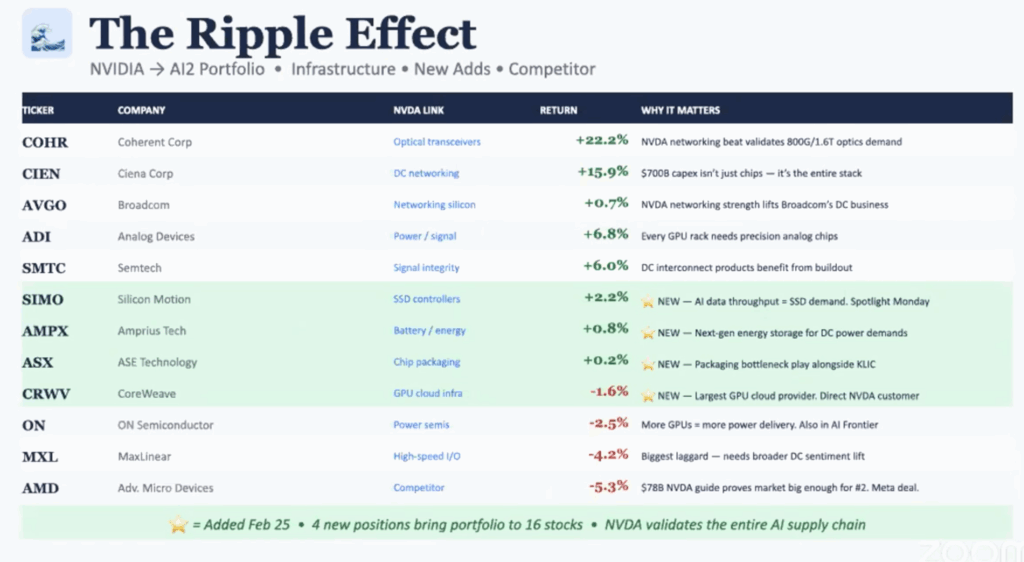
Every Nvidia chip that ships needs memory. It needs storage. It needs optical networking for speed. It needs packaging. It needs fabrication equipment. It needs power infrastructure. The entire AI supply chain moves when Nvidia moves — not on earnings day, but in the weeks and months that follow.
When Nvidia raises forward guidance by 15%, they’re not just telling you about Nvidia’s future. They’re telling you about the future demand for every company that builds the pieces and parts that make those chips useful.
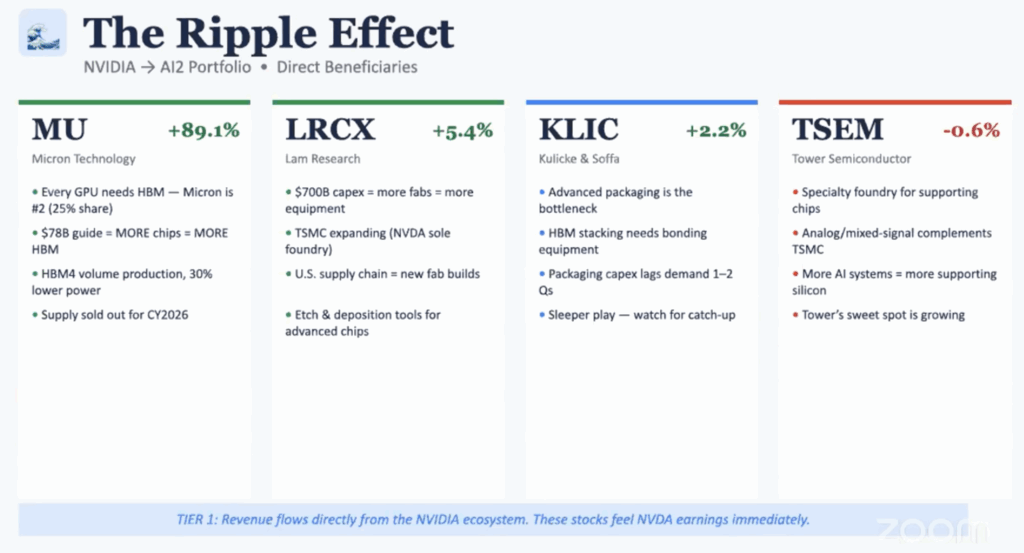
Here’s who benefits directly:
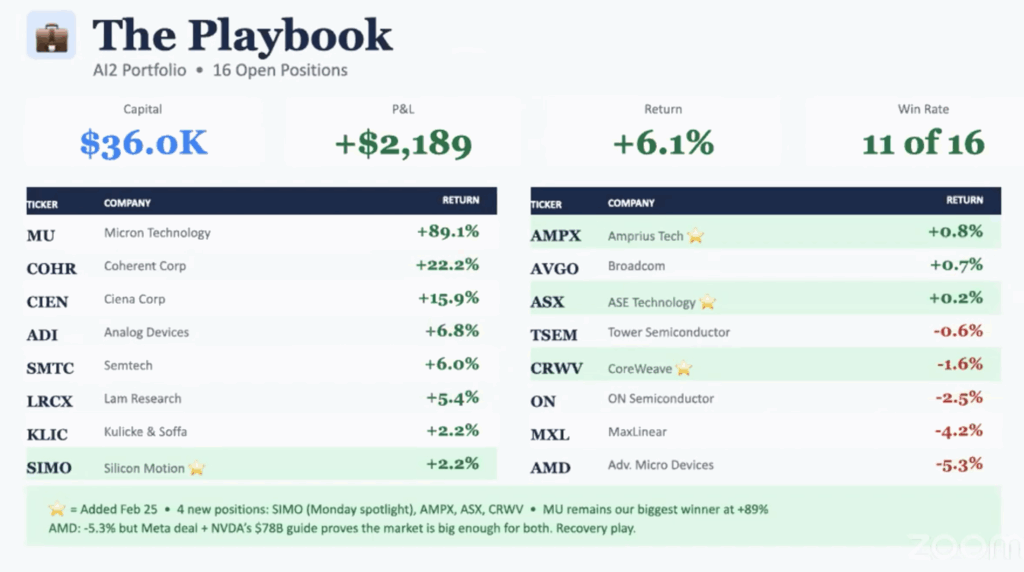
Memory and storage. Every GPU needs high-bandwidth memory. Micron — which we’ve been holding since November at an 88% gain — has its forward supply sold out through 2026 and is already taking commitments for 2027. Sandisk has exploded for the same reason. Silicon Motion makes the controllers that go inside the flash memory. These aren’t separate stories. They’re the same story, playing out across multiple companies.
Fabrication equipment. As chip demand rises, new fabs get built. Lam Research is a direct beneficiary — they make the equipment that goes into those fabrication plants. We’re holding them in the portfolio and they’ve been building gains steadily.
Optical networking. AI is useless if it’s slow. Coherent and Siena — both up 13% in our portfolio since last week — make the optical components that move data at the speeds AI requires. As data centers expand, these companies expand with them.
The Bottom Line
Nvidia just confirmed that AI demand is accelerating. The market shrugged. That’s fine — the market often tells you the wrong thing on day one.
What matters is the next 30 to 90 days. The supply chain companies we’re holding all have a stronger fundamental backdrop today than they did yesterday. Nvidia’s earnings beat isn’t about Nvidia. It’s about everyone downstream.
We’re sitting on 11 out of 16 positive positions in the AI2 portfolio. We added 4 new trades this week. And the thesis — growth at a discount in the AI supply chain — just got another data point in its favor.
The real Nvidia trade isn’t Nvidia. It’s everything Nvidia needs to exist.
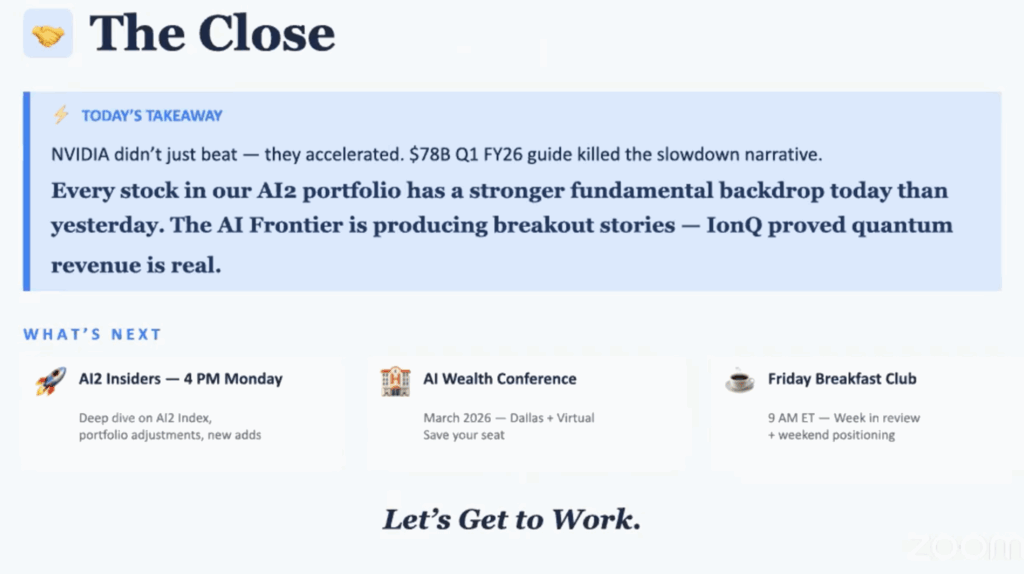
If you want to see the full ripple effect map, the segment-by-segment performance, and how we’re positioning after Nvidia’s earnings — AI2 Insiders is where it happens.
Disclosure: AI2 Insiders holds positions in stocks mentioned in this article. Past performance does not guarantee future results. All investments carry risk.
See What’s Coming at the Conference
I recorded a quick breakdown of the three strategies we’re bringing to Investor’s Blueprint Live on March 20-21 — and the results they’ve already produced this year. Eight minutes. Real numbers. No fluff.