

Welcome to the Breakfast Club, your weekly dose of market insights and trading strategies! Join us live every week at 9 AM ET on Traders Reserve Live, where John Hutchinson breaks down the latest market movements, shares actionable trade ideas, and answers your most pressing questions.
I want to tell you something that happened last week that the entire financial media got wrong.
Not partially wrong. Completely wrong.
Fourteen outlets covered MaxLinear’s earnings on April 24th. CNBC. Motley Fool. Yahoo Finance. Seeking Alpha. Zacks. Benzinga. All fourteen reported the earnings. Not one of them explained why the stock moved 76% in a single day.
Every single one of them explained the 30% move. None of them explained the other 46%.
And I’m going to tell you exactly what happened — because understanding it changes how you look at earnings season from here forward.
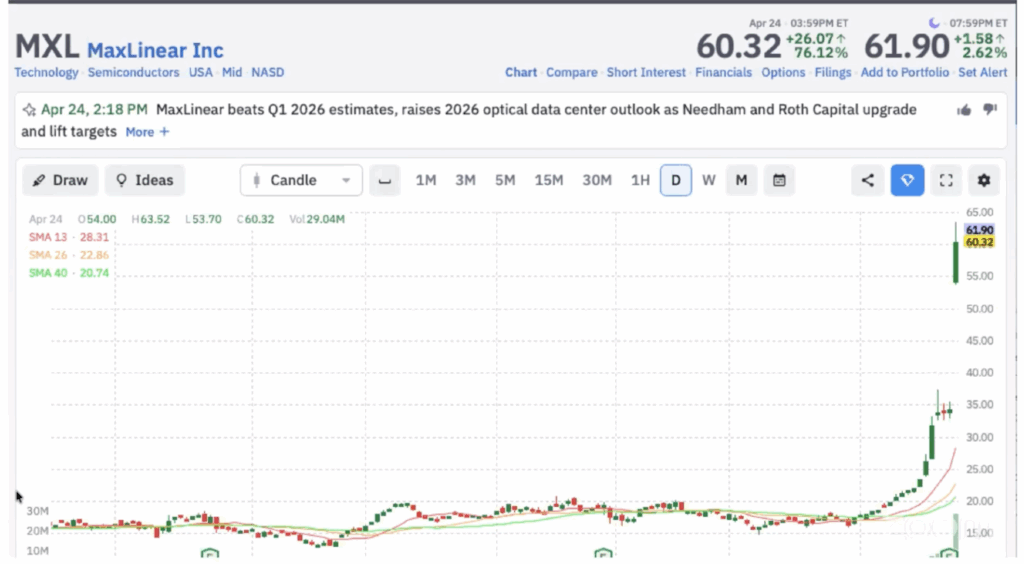
We’ve Held This Stock Since $19. Here’s the Full Story.
We entered MaxLinear in mid-February around $19.45. During the Iran sell-off in March, the stock dropped to around $16. We were sitting on a -23% position at the low. I held it because the fundamentals hadn’t changed. That’s the whole game — holding what you know is right while the market does what the market does.
Then the ceasefire was announced on April 7th. The optical sector — Lumentum, Corning, Ciena, MaxLinear — all started moving. By the end of the following week, MXL had recovered to around $23. Then the upgrades came: Susquehanna raised the price target to $30, and Needham — one of Wall Street’s most conservative research firms — upgraded the stock from hold to buy. That pushed it through $30.
Then last Monday, April 20th, something unusual happened in the options market. I told members about it at the time: options dealers had run out of strikes. They had no place to hedge. The stock was in the low $30s and the highest available strike for May and forward expirations was $35. Nothing in between, nothing above. When a stock moves into territory where dealers have no strikes available, they’re forced to buy shares to hedge — and that buying pushes the stock higher, which forces more buying. That’s a gamma squeeze. MXL moved 20% that Monday alone.
The CBOE scrambled. Tuesday they added strikes between $30 and $35. Wednesday they pushed the top available strike to $47. That brought us to Thursday’s earnings.
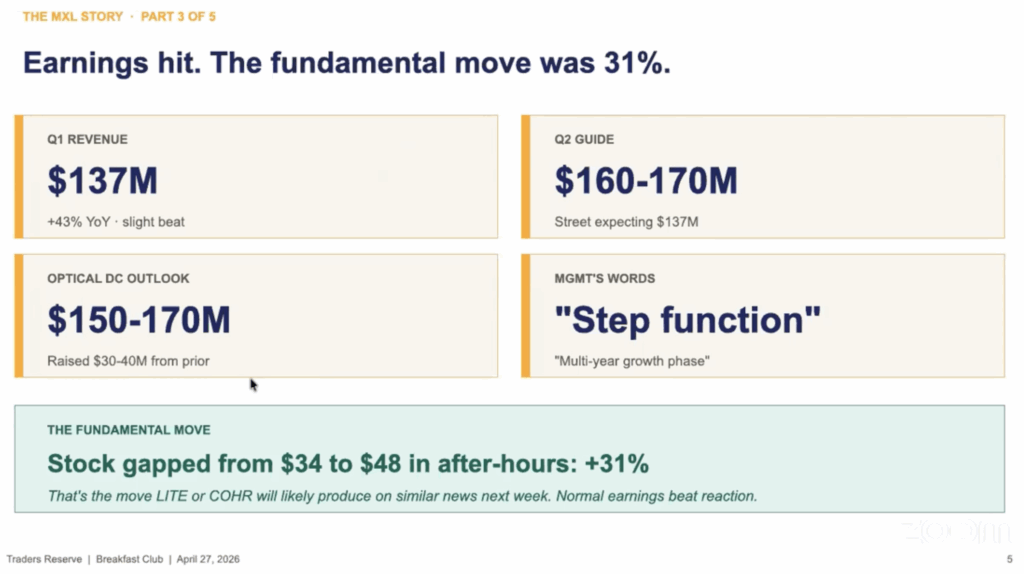
What Earnings Actually Said
The numbers were strong. Q1 revenue of $137 million, up 43% year over year, a slight beat. Q2 guidance of $160–$170 million against a Street estimate of $137 million. Optical data center outlook raised by $30–$40 million. And the two words that mattered most from management’s earnings call: “step function.”
Step function means their revenue and order acceleration is approaching a near-doubling of the business. That was not priced in. After-hours pricing jumped from $34 to $48 — roughly a 31% move. That’s the fundamental earnings reaction. Normal. Expected. The options market had priced in about 28% expected move either way.
But here’s where it got interesting. When the stock opened Friday morning, it didn’t open in the 40s. It opened at $54.
Why? Because there were no call strikes above $47. Every single call strike on the board was deep in the money when the stock opened. Every single put strike was deep out of the money. Dealers had no way to lay off their risk. They were forced to buy shares — at the open, through the early session, relentlessly — and that buying compounded the move from a normal 31% earnings reaction into a 76% single-day gain.
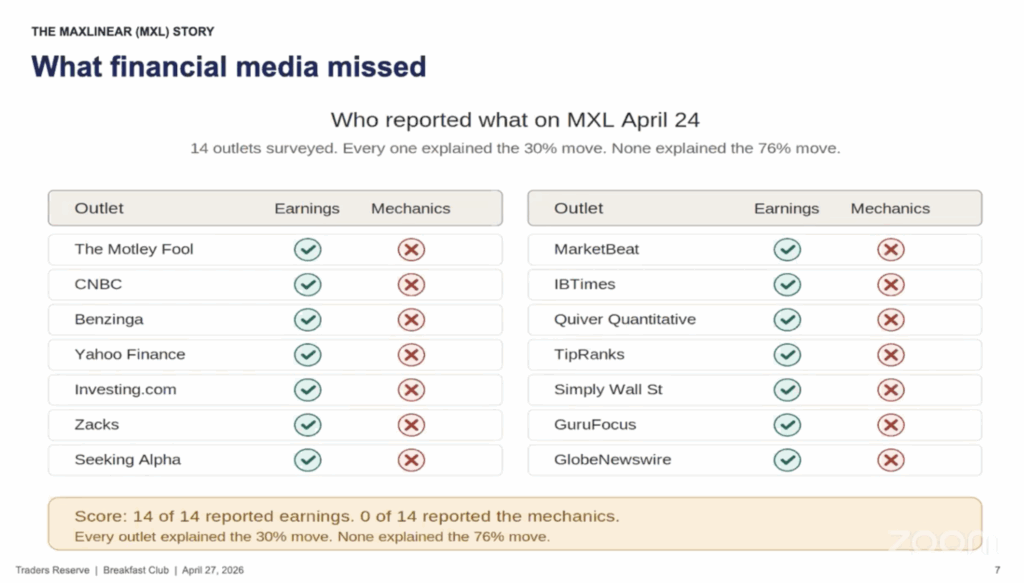
14 outlets surveyed. Every one explained the 30% move. None explained the 76% move.
This is also, by the way, a shortcoming of AI-generated financial reporting. Ask an AI to summarize MaxLinear’s earnings and it will tell you about revenue and guidance. It won’t look at the options chain. It can’t see what the dealers were doing. That’s where human analysis still has an edge — and it’s exactly the kind of edge we were positioned to benefit from.
MXL is now up over 220% from our February entry. We took a half position off on April 20th to lock in gains. The rest continues to run. The CBOE has now opened strikes up to $90. That tells me the move isn’t over. The gamma squeeze structure takes 2–3 weeks to fully unwind because of where institutions are positioned on the call side, and the next major expiration isn’t until May 15th.
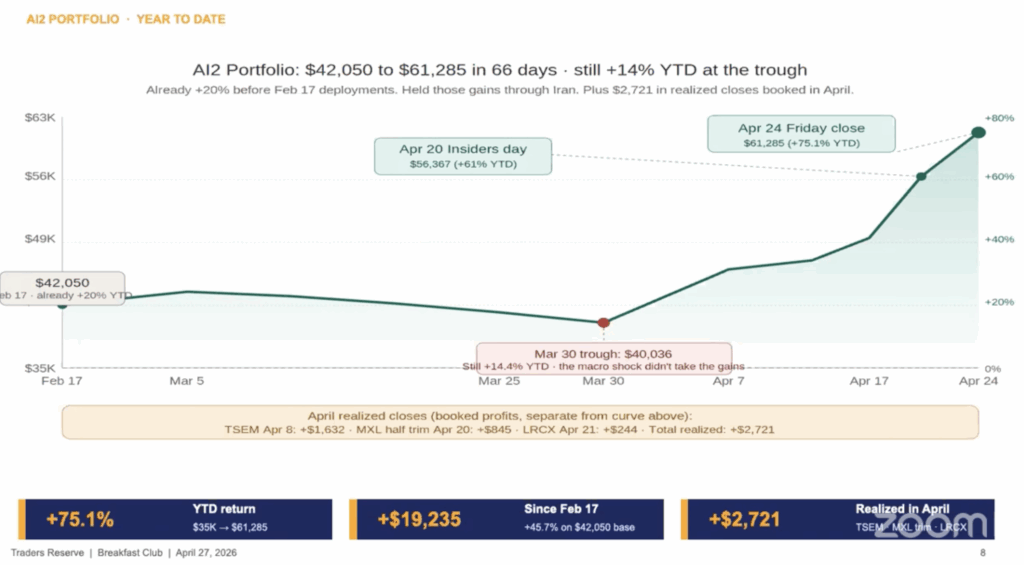
The AI2 portfolio went from $42,050 to $61,285 in 66 days. That’s +75.1% year to date. At the March 30th trough — the absolute low point during the Iran sell-off — we were still up 14.4% on the year. The macro shock didn’t take our gains. It just paused them.
We’ve realized $2,721 in booked profits in April alone across TSEM, MXL trim, and LRCX. We’re carrying roughly $18,000–$19,000 in total unrealized paper gains. And 13 of our 13 remaining positions are in the green.
The thesis is simple and it keeps proving out: when Wall Street wants risk, they go to artificial intelligence. Specifically to the supply chain — semiconductors, memory, optical, semiconductor equipment. These sectors have had multiple consecutive weeks of significant gains tracing directly back to the ceasefire announcement. But the magnitude of the moves implies something bigger: Wall Street is rapidly repricing these companies for a step-function change in future earnings, not just the current quarter.
Demand is outpacing supply across the entire chip chain. When companies like TSMC report +58% year-over-year profit and raise guidance, when Micron’s HBM is sold out through 2027 and they’re already taking 2028 orders on 3–5 year contracts, when MaxLinear says “step function” and “multi-year growth phase” — this is not a short-term trade. This is a structural repricing.
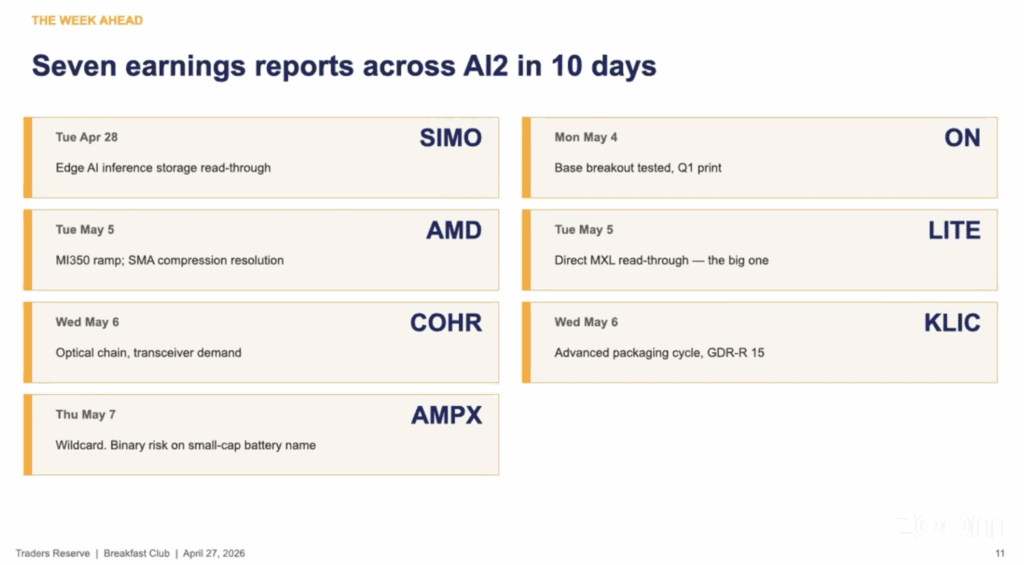
Seven earnings reports across AI2 holdings in the next 10 days. Silicon Motion tomorrow. Then AMD and Lumentum on May 5th — Lumentum is a direct MXL read-through and the one I’ll be watching most carefully given what we just saw in the optical sector. Coherent and KLIC on May 6th. ON Semiconductor May 4th. Amprius on May 7th — small-cap battery name, binary risk, wildcard.
And underneath all of it, the big tech capex story continues. Microsoft and Google both report this week. What I’m listening for is whether they maintain or increase their AI capital expenditure guidance. If they do, everything we’re already holding gets another tailwind.
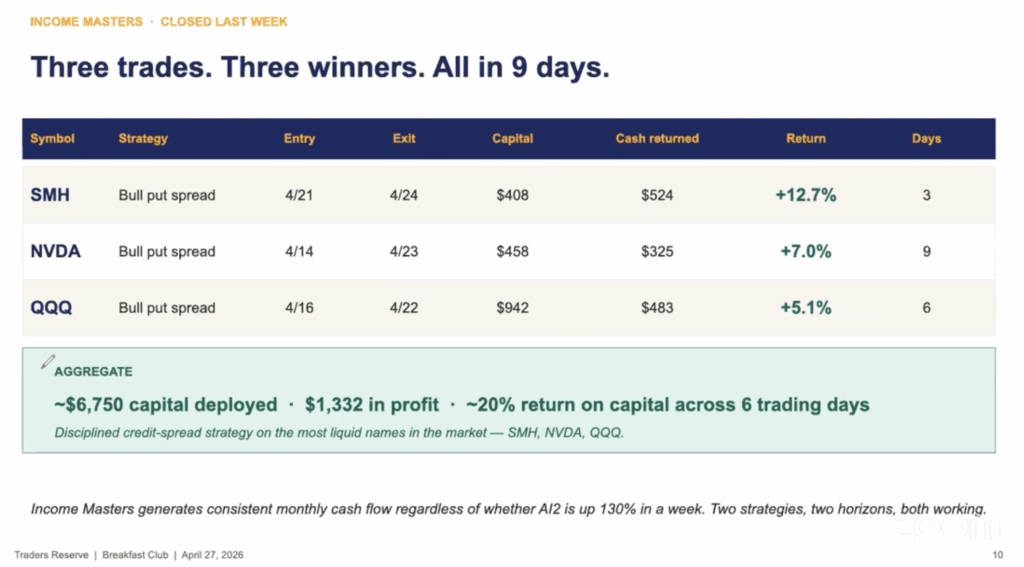
Income Masters closed three trades last week — SMH, NVDA, and QQQ — all profitable, $1,332 in profit, roughly 20% return on capital across about 6 trading days. Three for three. The SMH trade is worth noting specifically: the semiconductor ETF has now had a run of consecutive higher closes that hasn’t been seen in 12 to 13 years. Semiconductors are in a massive cycle change. If you’re looking for a place to start, that’s where I’d start.
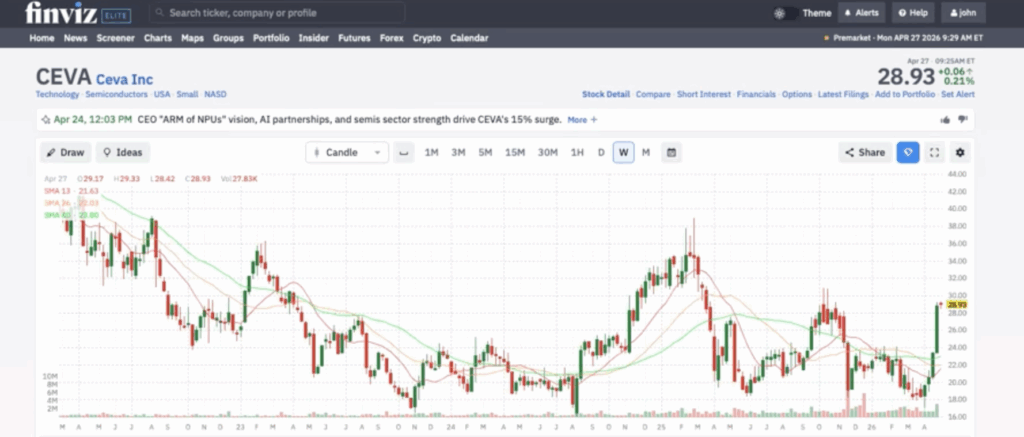
One more name worth keeping on your radar: CEVA Inc. We held this one earlier in the year, gained about 1%, and let it go. It just moved 17% in a single day on news about the CEO’s vision for becoming the “ARM of NPUs” and AI partnerships. Now sitting at a longer-term resistance level. If it clears that, it becomes interesting again. We’ll be watching.
The AI supply chain is still in the early innings. We’re not done building. Not even close.
AI2 briefing today at 4pm. Next Breakfast Club: Monday, May 4th.