
Welcome to the Breakfast Club, your weekly dose of market insights and trading strategies! Join us live every week at 9 AM ET on Traders Reserve Live, where John Hutchinson breaks down the latest market movements, shares actionable trade ideas, and answers your most pressing questions.
What if this ends and oil goes lower than it was before any of this started?
Trump said something in an interview yesterday that most people filed under “politician being optimistic.” He said prices are elevated right now because of the conflict — but once it ends, they could drop lower than ever before. Most people heard that as cheerleading. I heard it as a scenario worth taking seriously.
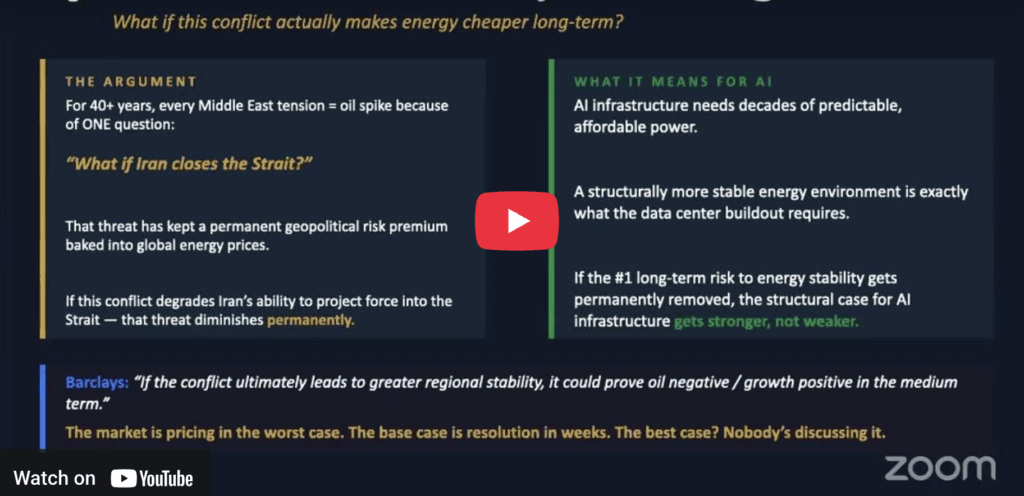
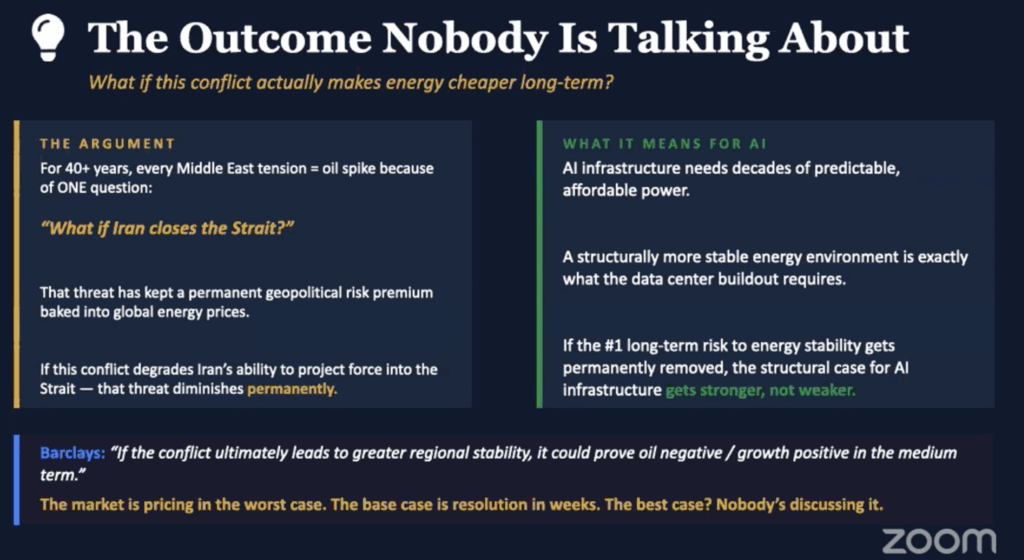
Because if you actually think through what would have to be true for that to happen — and what it would mean if it did — you end up somewhere that almost nobody in financial media is willing to go right now. They’re all staring at the war premium baked into oil today. I want to talk about what happens on the other side of this thing.
Barclays put out a note touching on this. The idea is that a resolution here doesn’t just mean ships moving through the Strait of Hormuz again. It could mean a fundamentally more stable Persian Gulf region than we’ve seen in decades.
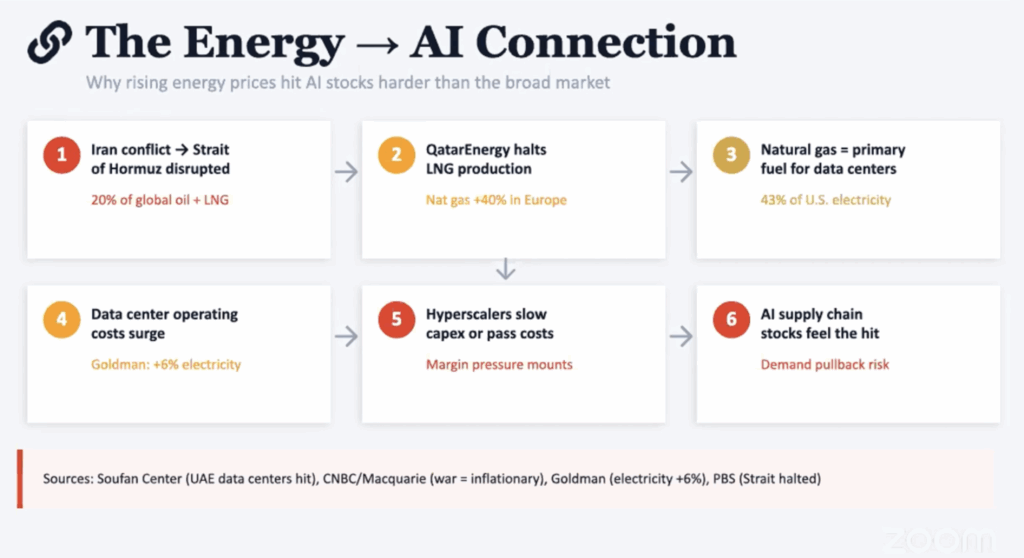
Right now, data centers — the backbone of every AI product and service you use — run primarily on natural gas. When you heard yesterday that Qatar Energy, a major LNG producer, took a missile strike and natural gas prices in Europe jumped 40% in a single day, that wasn’t just an energy story. That was an AI story.
If the Persian Gulf stabilizes, if proxy threats are reduced, if oil and natural gas move meaningfully lower — and stay there — then the cost structure for every data center being built or planned right now improves dramatically. We’re talking about over $700 billion in planned AI infrastructure spending this year. Lower energy costs don’t just protect margins. They potentially expand them. That flips the script completely.
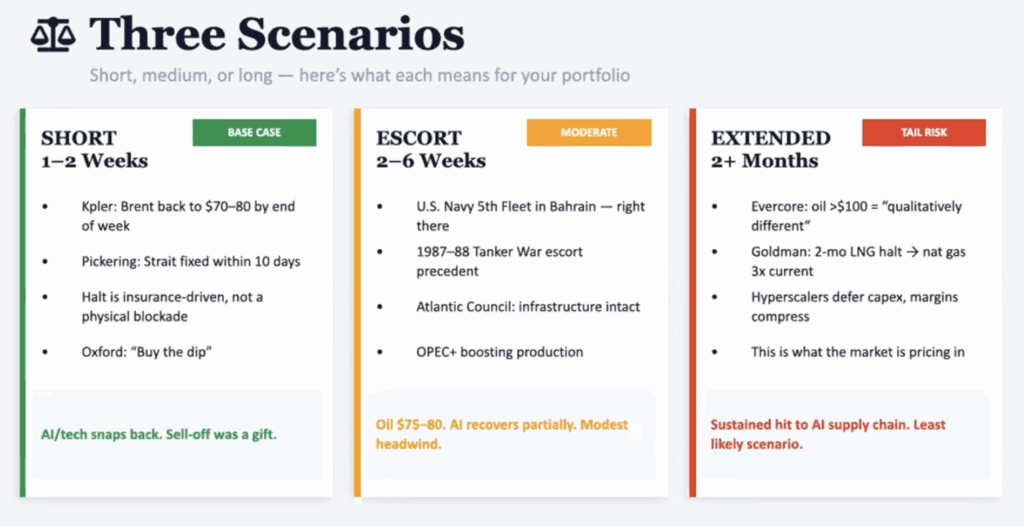
The base case is resolution in 1-2 weeks, with Navy escorts beginning and insurance concerns fading. There’s historical precedent for this — the tanker wars of 1987-1988 ended with exactly this kind of intervention.
The best case — the one nobody’s talking about yet — is everything I just described above. A more stable region, lower energy prices, and a tailwind for AI infrastructure costs that lasts years, not weeks.
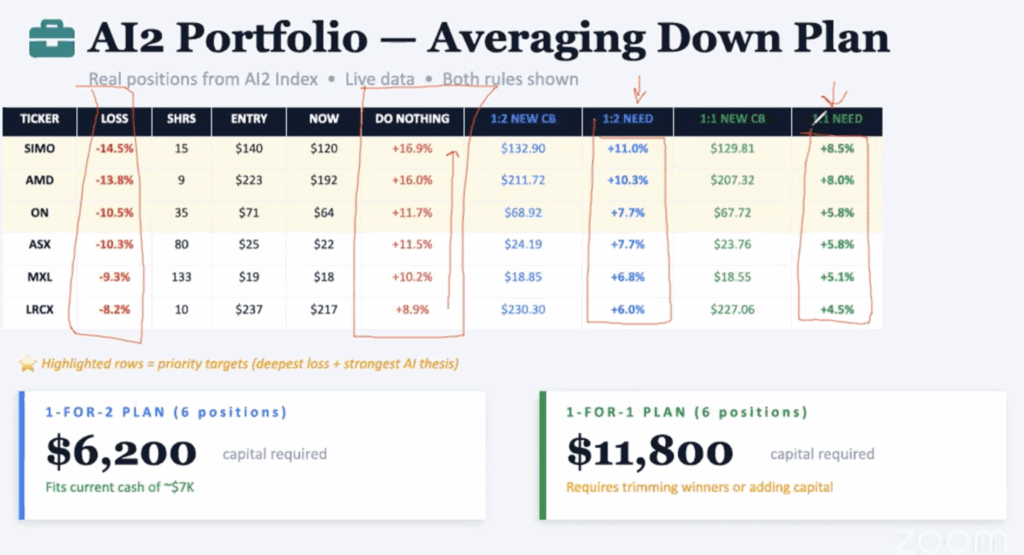
The risk is timing. You don’t want to average down only to watch the stock drop another 10% the next day. My approach is to wait for a confirmed 2-to-3-day upstretch before I pull that trigger. I want some technical confirmation that the floor is in before I add.
The companies I’m watching for this — Silicon Motion, AMD, ON Semiconductor, ASE Technologies, Marvell, Lam Research — all have strong fundamentals. Rising sales, rising earnings, real growth prospects. These are not going to zero. The question isn’t whether to hold them. The question is how quickly you can get back to break even and make a more informed decision from there.
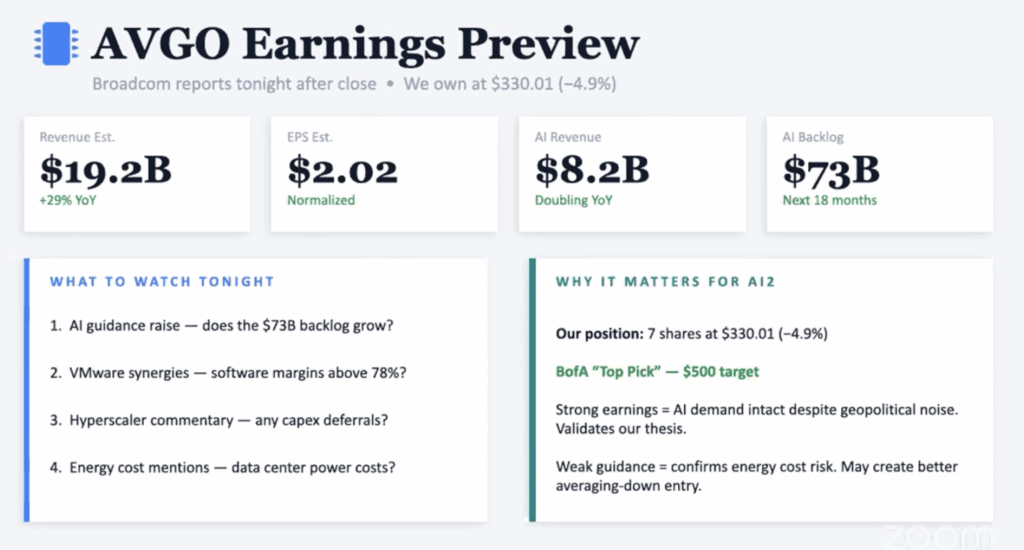
On Broadcom Tonight
First, margins from the VMware acquisition. That was a high-margin, high-growth product line when Broadcom absorbed it, and the question is whether that margin profile has been maintained or expanded.
Second, the backlog picture — specifically in the context of what happened with Nvidia last week. When a chip giant shows excess supply in one product line, you have to ask the same question across the sector.
The Bottom Line
Yesterday was frustrating. The day before was frustrating. But we’re bouncing today for a reason — the worst-case scenario is being walked back. Micron is up 2.5% at the open. Siena is up. The market is not telling you this is over, but it’s telling you the absolute floor-of-the-earth scenario is off the table.
As Warren Buffett put it: when everyone else is afraid, that’s the time to be greedy.