
Welcome to the Breakfast Club, your weekly dose of market insights and trading strategies! Join us live every week at 9 AM ET on Traders Reserve Live, where John Hutchinson breaks down the latest market movements, shares actionable trade ideas, and answers your most pressing questions.
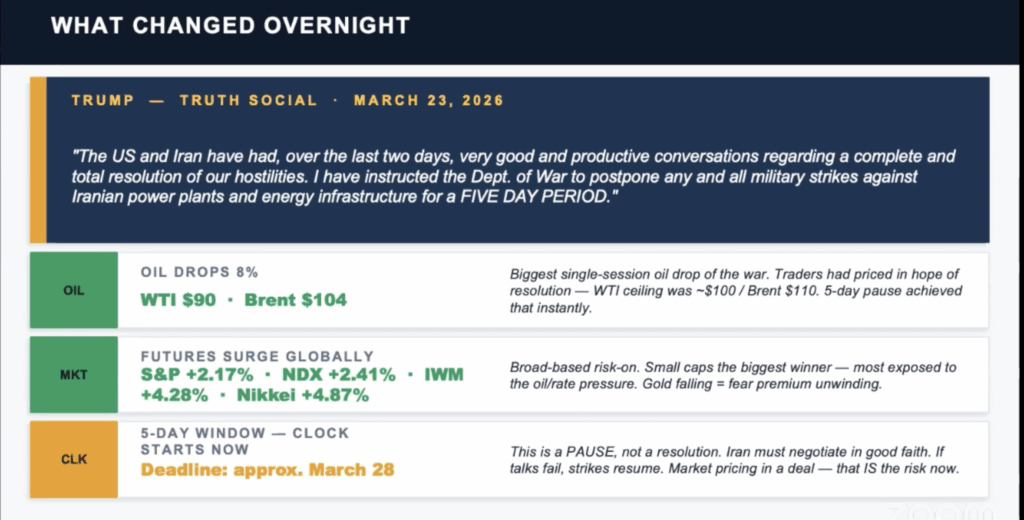
That’s the good news. And it’s real good news — the biggest single-session oil drop of this entire conflict.
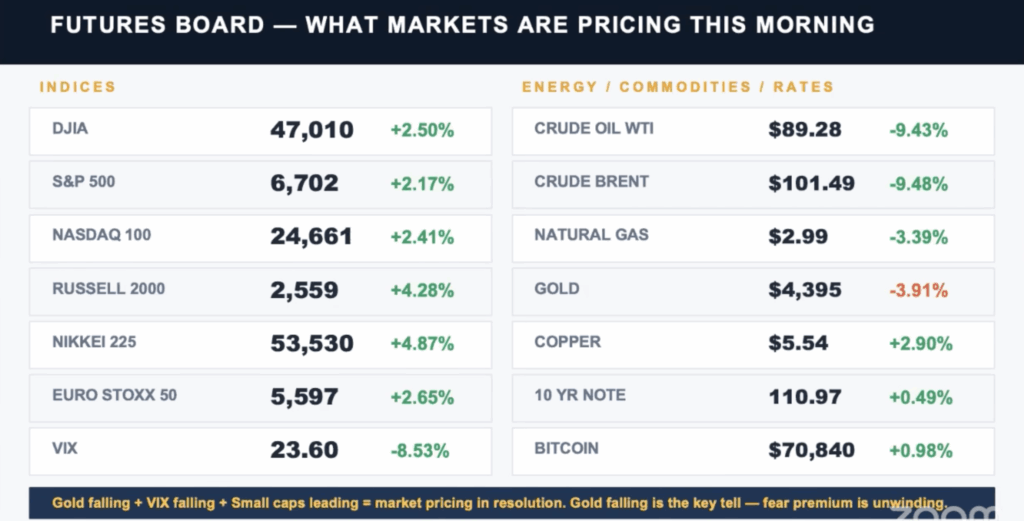
A five-day pause on strikes is a negotiating window. Iran still hasn’t confirmed anything. The Strait of Hormuz is still not open. And there are three hard deadlines running simultaneously this week — not one — and the market is currently pricing in the best possible outcome on all three. That’s where the risk lives right now.
Clock one — Trump’s five-day window (deadline: ~March 28). The pause buys time for Iran to negotiate. If Iran engages seriously, oil stays down and the rally extends. If Iran doesn’t confirm — or worse, resumes threats — the pause was a head fake and we’re right back to where we were Friday. The market is pricing in a deal. That is now the risk.
Clock two — The CFO council warning (deadline: ~April 1). A CFO council covered by CNBC over the weekend put it plainly: US businesses are giving Trump until roughly the end of March. After that, CFOs cannot guarantee visibility into earnings, revenue, or labor. Capital advisor John Kilduff went further — if the Strait isn’t meaningfully reopened by April 1, oil reprices to $170–$200 a barrel. United Airlines’ CFO said he’s already hedging at $175. He has to. Airlines buy fuel years in advance, and right now he’s planning for the worst.
Clock three — SPY put options expiring this Friday, March 27th. This is the one most people aren’t talking about. Pull up the options chain.
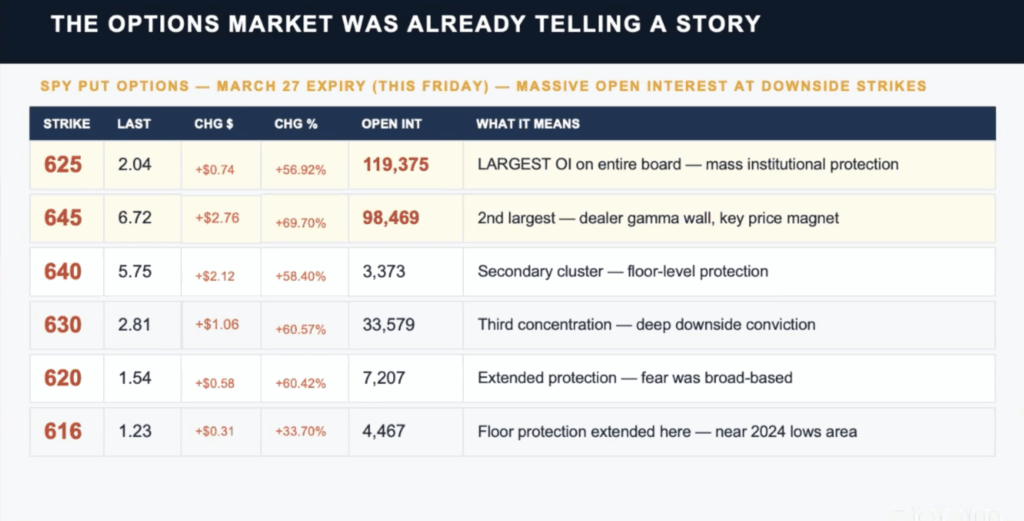
Nearly 120,000 contracts sitting at the $625 strike. Almost 100,000 at $645. Those were the largest open interest positions on the entire SPY board going into the weekend — institutions buying mass downside protection at levels 5–8% below where the market was trading. That positioning was built before Trump posted anything. It tells you what the smart money thought was coming.
Those puts are losing value fast this morning as the market surges. If SPY holds above those strikes through Friday, 119,000 contracts expire worthless and institutions are forced to unwind their hedges — potentially adding fuel to an already-moving rally in the form of a short squeeze. But if Iran doesn’t confirm and the market reverses, those puts come screaming back into play. Friday is a pressure point regardless of which direction we’re heading.
What to Watch, Day by Day
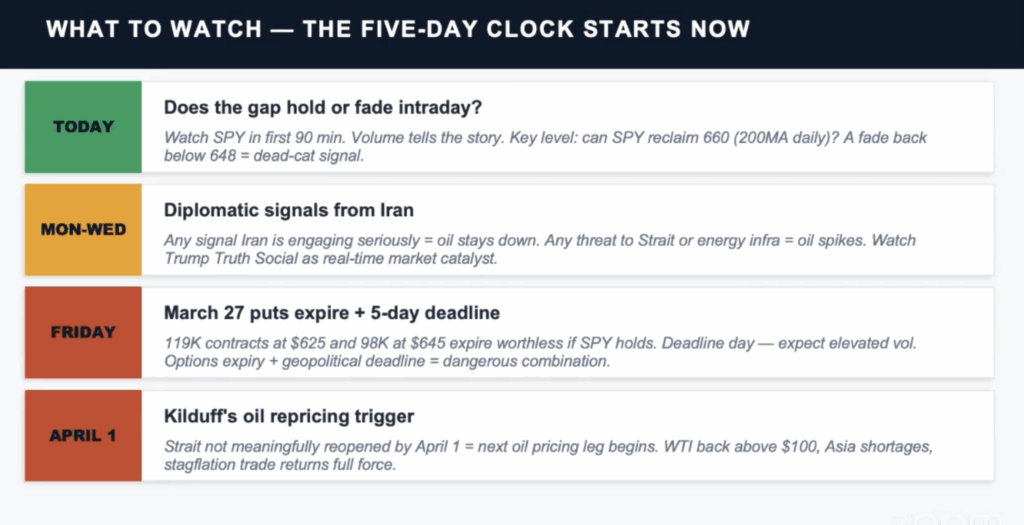
Today: Watch the first 90 minutes. The key level is SPY 660 — the 200-day moving average. If the market can reclaim and hold that level, this rally has structure. A fade back below 648 after the open is a dead-cat signal — the kind of reversal we saw every single day last week.
Monday through Wednesday: Watch Iran, not just Trump. Any signal that Iran is engaging seriously in talks keeps oil down and the rally alive. Any threat to the Strait or energy infrastructure sends oil back up. Trump’s Truth Social is now a real-time market catalyst — treat it that way.
Friday: Options expiry and the five-day deadline land on the same day. That combination — 119,000 contracts at $625 expiring alongside a geopolitical deadline — means elevated volatility regardless of direction. Be ready for it.
April 1: The hard backstop. If the Strait isn’t meaningfully reopened, Kilduff’s oil repricing trigger kicks in. Everything that happened over the last several weeks gets worse from there.
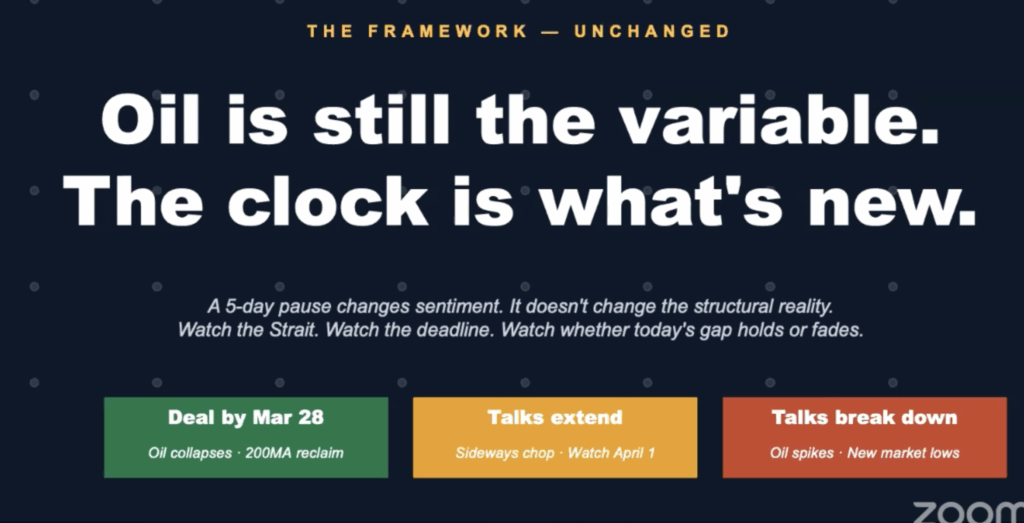
Three outcomes. Three very different markets.
Deal by March 28: Oil collapses toward $75–$85, the 200-day moving average gets reclaimed across indices, and the market starts a sustained recovery. Rate cuts come back on the table. The Fed looks through the temporary inflation spike.
Talks extend: Sideways chop. The market waits. Watch April 1 as the next pressure point.
Talks break down: Oil spikes back above $100, CFO earnings visibility collapses, new market lows. This is what 119,000 put contracts were positioned for.
I’m not going all in on a single morning’s move. I want two to three days of stable, orderly closes — not gap-up opens — before I make meaningful moves in the AI2 portfolio. A one-day 8% oil drop is a yay moment. It’s not a trend yet. The last several weeks were full of strong Monday opens that gave everything back by Friday.
Watch the close today. Watch Iran. Watch oil. The clock is running.